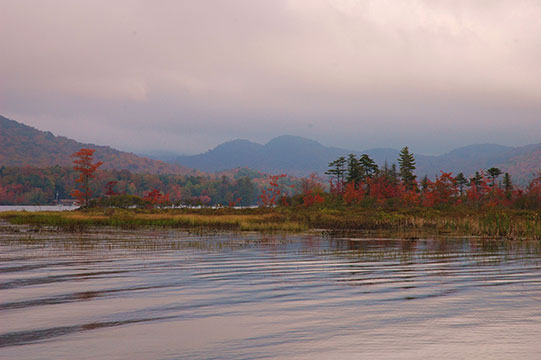
Caroga Times
Nostalgia & Memories
Nostalgia and memories. This what this site was all about. Thank you Tony.
The new owner of the domain has kept an edited version of the orignal content to give visitors a glimpse of what Caroga Times offered its visitors.
Content is from the site's 1999-2011 archived pages.
Enjoy!
Once you get into this site you'll want to just take your time, relax, and enjoy the sights, sounds, and memories of the magic of summers at Caroga Lake.
So, get a cup of coffee, sit down and turn up your sound. You'll love the potpourri of our "Caroga Times." You will want to check out our "Memories of Johnstown" section too!
Tony Ermie
"Caroga Times"
Memories of Sherman's - Willie's - Pine Lake - Caroga
Don't Miss It!
Frank Sherman
Pictures and Interesting Insights into the Man Who Built Sherman's
New! Latest Caroga Pictures - May 2002
Also added a bunch of pictures in the "Memories of Johnstown" section (below)
Walter J. Hogan Collection
Great old pictures of Sherman's from the owner of "Hogan's."
Pictures of the flood at Sherman's
Some of My Favorite Pages
Stories of Caroga
A Must Read and See!
Messages From Our Friends & Visitors
Leave a message, or "hear" from people you know!
Fall 2000
Some great shots of our recent 10/2000 trip to Caroga
You'll know many of the people, places and things.
Lil Joe's Caroga Lake Museum
Joe Riccardi's Collection of Hog & Caroga Collectibles
Caroga Remembers Its Past
Nostalgic Pictures and Dialog of Caroga's Early Days
From "Caroga - An Adirondack Town Remembers Its Past" by Barbara McMartin
Caroga Pictures from Our Friends & Visitors
Many Great Miscellaneous Shots and Dialog
From the 1920's to Present
Caroga & Fulton County Area Scenery
Fabulous Shots and Dialog of the Area
Some Familiar Caroga "Places"

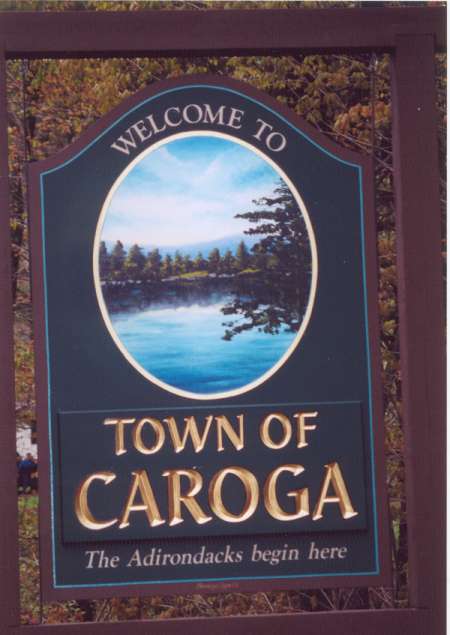
Beautiful Welcome Sign to Caroga
Spent a few days this May (2002) in Caroga, so here's a few pics from this recent trip. The weather, for the most part, was unusually cold and rainy, but a refreshing relief from the 100 degree California heat.
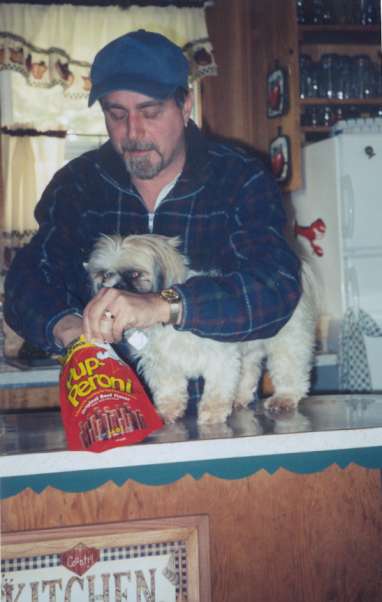
My cousin, Larry D'Alessandris, graciously allowed me to stay at his camp (Nestorest) during this time. Its'a always'a good'a to have a counsin'a ina New York'a. :) Here he is in the kitchen of Nestorest with his dog Abby. Nothing but the best for his Italian "Abby" - Pup-Peroni!
"Caroga Times"
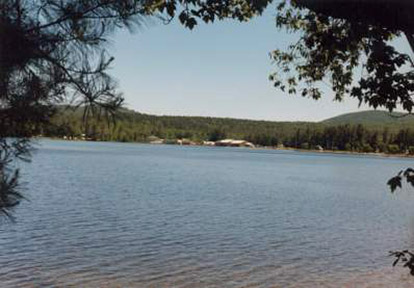
Were You Here 'Yesterday' When It Was Still...
Morning In Caroga?
Then you'll love our...
"Caroga Times"
They began in the spring of 1952 at Camp Nestorest on Forrest Ave. It was an adventure on the lake, with the Adirondacks for a backyard.
NestorestThings to do. Places to go. Fish to be caught. Ice to skate on. Snow to play on. Forests and streams to explore. An amusement park with a Penny Arcade that, to us, was the first Disney Land.... Especially the "penny" part.
From "Nestorest" one could hear the music from the Merry-Go-Round. Smell the tantalizing aroma from the fresh popcorn that Frank Sherman sold for 10 cents a bag (fifteen for peanuts).
On a quite nights, sitting by the nightly "altar" of the Adirondack fire, the soft lapping of the lake could be heard as it kissed the beach goodnight.Later in the evening you could hear the music wafting over from the big bands that played in Sherman's dance hall.
In later years the music from Willie's juke box could be heard across the entire lake!While you waited for sleep to come - the joyful patter of the light rain hitting the roof reminded you that the fishing would be great in the morning.
So, join us as we share our "Caroga Times"... For you were, somewhere along the way, there.
Tony Ermie
Connected To The Cyber World
Caroga might be hidden away in the woods, but our digital connection is strong and vibrant. My parents have been living here for years, enjoying its peacefulness while staying plugged into the cyber world. They're regulars online, often using facetime to see their grandkids growing up. One day, while doing some spring cleaning, my mom realized her favorite Superman t-shirt was nowhere to be found. She was quite upset, as that shirt held sentimental value. Thankfully, our reliable internet access came to the rescue. I quickly logged onto the site and found the exact same shirt, ensuring it was delivered to our doorstep the very next day. My mom is particular about her superhero gear, but thankfully, MoonAtMidnight.com had us covered. We also indulge in streaming movies from Netflix and Amazon Prime. So, for anyone considering a summer retreat here and worrying about staying connected, fear not - our little slice of heaven is as online as it gets.Small Town Makes The Big Time
There was an article in the City Beat, a free street mag that's into snark. The lead story the other day was about a con man named George Binakis who defrauded elderly folks in New York City by promising to renovate their condos. George Binakis is not a licensed contractor, but in one case he was able to con a 72 year old woman out of $65,000 by posing as one and then gaining her trust and sympathy. His sob story involved a serious heart condition requiring a pacemaker and constant monitoring. So successful was the con, that when George Binakis disappeared with her money, her first thought was for his well being. And George has vanished, but this is where City Beat's snark comes in. They facetiously write that George Binakis "probably headed to some distant, prearranged hideaway somewhere in Caroga..." And the national press has reprinted that quote so our small space has become center of attention like you would not believe!
Glenn Harris recalled as `unique legislator'.....
Passed away in Florida on June 29, 2002
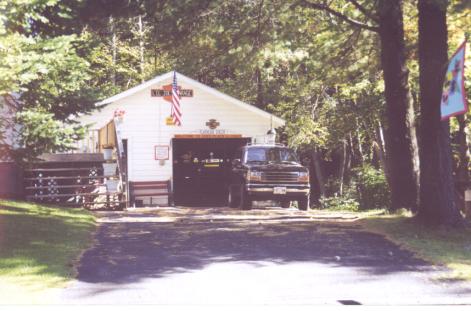
Joe Riccardi's
Caroga Lake "Museum" 6/01
You ain't seen nothing until you've checked out "Lil Joe's" Museum! Wow! I've never seen so many Caroga, Harley, Indian, etc. collectibles. At first glance it all looks like a pile of junk, but when you really start looking among his souvenirs you'll be impressed!
The following pictures only touch on a few of the many, many items and treats in store for you when you visit.
Joe said he'll give personal tours for up to 4 people at a time for only $60 an hour. :-)

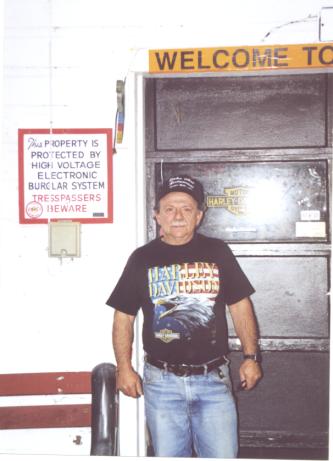
Here's Joe, the "Curator", in front of his "Museum."
The "High Voltage Electronic Burglar System" really works as I found out when I saw a dog attempting to lift his leg against the building. PUFF! The dog and his wee wee were wiped out in a cloud of mist!
Joe and I go back over four decades! Yikes! I would be at his fathers camp playing my accordion while Joe's father would be on the drums telling some incredible jokes as he drummed along. After a few minutes I couldn't play anymore as I was laughing my butt off!
He's so very proud of his daughter's (Colleen Graves) new music CD "Taken By Storm." Rightfully so, she has a fantastic voice. You can even hear Joe's Harley (he had it on a dynamiter) as he revved up the engine in the "Motorcycle Riders."
"Ladies of the Lakes"

"Ode to the Red Hat Society"
by Sue Ellen Cooper
A poet put it very well. She said when she was older,
She wouldn't be so meek and mild. She threatened to get bolder.
She'd put a red hat on her head, and purple on her shoulder.
She'd make her life a warmer place, her golden years much golder.
We read that poem, all of us, and grasped what she is saying.
We do not need to sit and knit, although we all are graying.
We think about what we can do. Our plans we have been laying.
Instead of working all the time, we'll be out somewhere playing.
We take her colors to our hearts, and then we all go shopping
For purples clothes and hats of red, with giant brims a-flopping.
We're tired of working all the time, and staying home and mopping.
We order pies and chocolate fudge, and rich desserts with topping.
We crown ourselves as duchesses and countesses and queens.
We prove that playing dress-up isn't just for Halloween.
We drape ourselves in jewels, feathers, boas, and sateen.
We see ourselves on television and in magazines.
We laugh, we cry, we hug a lot. We keep each other strong.
When one of us goes out for fun, the rest all go along.
We gad about, we lunch and munch, in one big happy throng.
We've found the place where we fit in, the place we all belong.
I first heard about the "Red Hat" Ladies of the Lakes from Sally Malagisi. She was so excited about the chapter that just started, not to mention that red and purple were a few of her favorite colors. Anyway I was supposed to take a few pictures of the "ladies" just before they embarked to the Glove theatre to see "Hello Dolly," but some circumstances beyond my control prevented me from taking the pictures. "Red" HOT Sally let me know in no uncertain terms that she was somewhat, to put it nicely, ticked off at me for NOT being there to take pictures. I decided I'd better get some pictures of the ladies before Sally scratched my eyes out.
I discovered that the following Monday (8/9/04) they were to have another meeting at the "Coffee Shop" in Caroga around 9 am. Setting TWO alarms, the night before, so I wouldn't be late I got up early and rushed to get there.
I made it in time to see some of the locals, as they were driving by the Coffee Shop, almost crash into each other as they saw the ladies with their purple outfits, boas, and red hats entering the coffee shop! It was a riot watching the looks on their faces as they drove by, no doubt wondering what these wild looking ladies were up to!
"The Red Hat Society began as a result of a few women deciding to greet middle age with verve, humor and elan. We believe silliness is the comedy relief of life, and since we are all in it together, we might as well join red-gloved hands and go for the gusto together. Underneath the frivolity, we share a bond of affection, forged by common life experiences and a genuine enthusiasm for wherever life takes us next."
Sue Ellen Cooper, Queen Mother
I went inside and took the following pictures of this delightful group. Of course Sally Malagisi wasn't there. She had to take her sister to the doctors and couldn't attend. Don't you think I didn't rib her a ton about not being there. :)
New!Penny Arcade Style Caroga Museum Completed
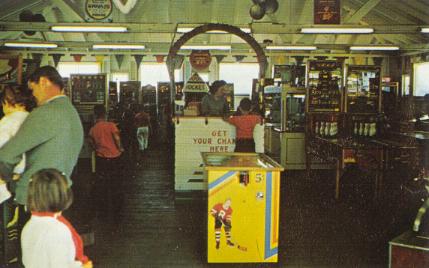
..In Memory of Frank Sherman
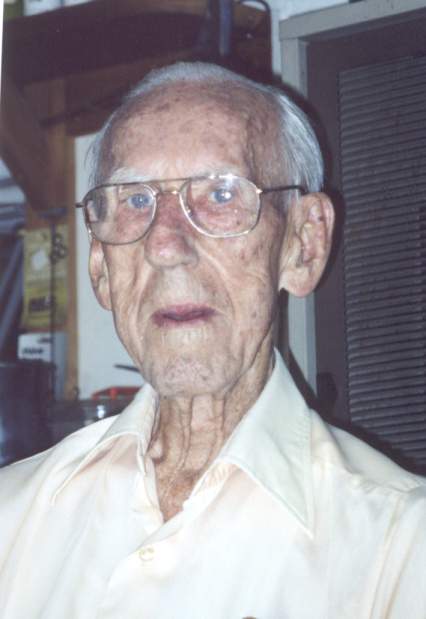
Frank Sherman (9/2000)
After months of discussion, and much work, a new Museum building in honor of Frank Sherman has been built on the grounds of the Caroga Lake Museum.
Janet Sherman Shepard has generously offered to fund the new building in memory of her late father who, to many of us, was the Walt Disney of the Adirondacks. The building is approximately 30' x 40' and in the style of the old Penny Arcade Building with the ramp entrance and original sign on the roof. It houses artifacts and information from Sherman's, including many personal items of Frank Sherman and family.
If you have some Sherman's Amusement Park memorabilia, that you would like to donate, please bring it to Linda Gilbert at the Caroga Town Hall. As we receive more information about the new building and its progress I'll post it here.
p.s. Had a number of pictures of the new building, but lost them all due to a "glitch." Will get some up next Spring
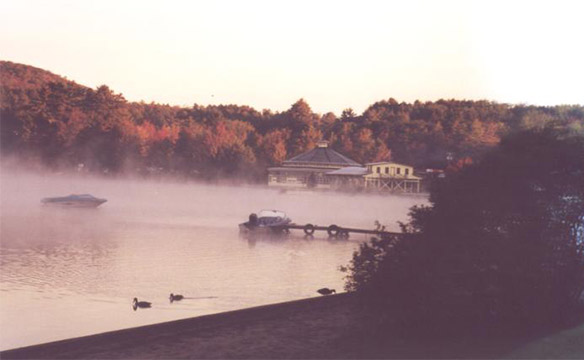
Sherman's At Sunrise 10/2000
What can we say. You that have been here know the feeling. The quiet early mornings with the lake mist slowly wisping away under the morning sun. The fresh smell of the morning dew as you walk along Caroga's shore. The soft contented giggles of the ducks as they cruise the morning shore for breakfast. The gentle lapping of the lake as it awakens, stretching to the beach.
The memories flood your mind with the joy and happiness of life's little treasures that only you understand, feel, and remember.

Fall 2003
Colors just starting to come out
Pic Courtesy of Bob and Kandy Sprung - Caroga Lake
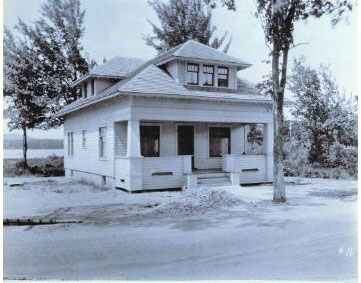
Sherman's 81 Years Ago!
Floyd Sherman home (1919) the year before Sherman's Amusement Park was built. It's now owned by Bob and Kandy Sprung. The Merry-Go-Round and Whip were built behind and just to the left of the house. Meade Creek runs to the right.
If you look close you can see the lake and the car tire trap (left side near road) that Floyd has next to the house. If you drove over it, I guess you would be there for a while.
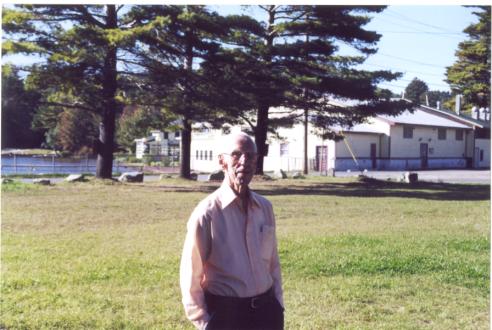
Frank Sherman (9/27/2000)
Here he is with his life's work literally behind him.
Frank had just celebrated his ninety-first birthday September 4th, 2000. His retirement home is but a few feet behind the camera.
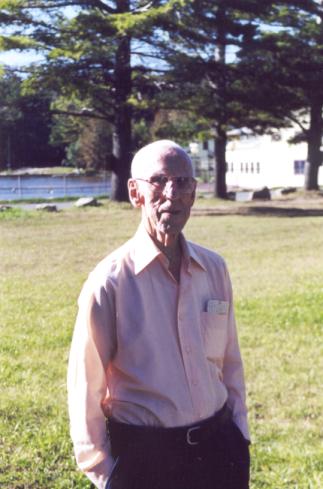
I stopped over to see him and explained that a number of people had emailed me asking about him, or asking to see a picture of him on the "Caroga Times" web site. He, as is often the case, was not in much of a mood to talk, but did allow me to take a few pictures of him.
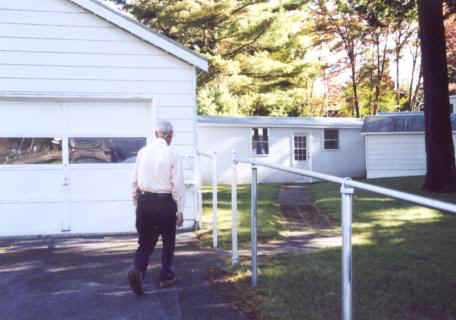
In a minute or two he just walked back into the house. There were so many questions I wanted to ask him, but the timing wasn't right. I thought I would never get an opportunity to get him to talk of the beginnings of Sherman's.
We were leaving for California the next week and I had little hope of this quiet, private man even answering the few questions I had for him, but I was in for a remarkable surprise just four days later.
Yes, there is a huge state beyond New York City and it is called Upstate New York. It has some beautiful large cities and is also full of MANY, MANY small towns and abundant farm land which we call Rural New York.
Here is someone's take on "Rural New York" and it's quite accurate.
This comes from Amy Barone Cannizzo my old Caroga Friend of almost 60 years! Thank you Amy!
THE RULES OF RURAL NEW YORK ARE AS FOLLOWS: Listen up City Slickers!
1. Pull your droopy pants up. You look like an idiot.
2. Turn your cap around straight... your head isn't crooked.
3. Let's get this straight; it's called a 'dirt road' No matter how slow you drive, you're going to get dust on your Lexus. Drive it or get out of the way. I drive a pickup truck because I want to.
4. They are cattle. They're live steaks. That's why they smell funny to you. But they smell like money to us. Get over it. Don't like it? I-90 and I-81 go west and south. . . . use em.
5. So you have a $60,000 car. . . . we're impressed. We have $250,000 combines to harvest corn and soybeans that are driven only 3 weeks a year.
6. So every person in rural New York waves. It's called being friendly. Try to understand the concept.
7. If that cell phone rings while an 8-point buck and 3 does are coming in, we WILL shoot it out of your hand. You better hope you don't have it up to your ear at the time. . . .
8. Yeah, we eat meat, 'taters and gravy, beans and biscuits, and home made pie. You really want sushi and caviar? It's available down at Jim's Bait Shop. . . .
9. The 'Opener' refers to the first day of deer season. It's a religious holiday held the Saturday before Thanksgiving.
10. We open doors for women. That is applied to all women, regardless of age.
11. No, there's no 'vegetarian special' on the menu. Order steak or chicken. Or, you can order the Chef's Salad and pick off the 2 pounds of ham and turkey.
12. When we fill out a table, there are three main dishes: meats, vegetables, and breads. We use three spices. . . . salt, pepper, and ketchup. Oh, yeah. . . . We don't care what you folks
in Chicago call that stuff you eat. . . . IT AIN'T REAL CHILI !!
13. You bring 'coke' into my house. . . . it better be brown, wet and served over ice.
14. You bring 'Mary Jane' into my house, she better be cute, know how to shoot, drive a truck, and have long blonde hair.
15. The Syracuse Orangemen and high school football are as important here as the Giants and the Jets and more fun to watch.
16. Yeah, we have golf courses. But don't hit the water hazards. . . . it spooks the fish.
17. Colleges? We have them all over. We have Cornell University, Ithaca College, Syracuse U., Colgate, the SUNY system, Community Colleges, and Voc-Techs. They come
outta there with an education plus a love for God and Country, and they still wave to everybody when they come home for the holidays.
18. Turn down that blasted car stereo! ! ! ! That thumpity-thump crap ain't music anyway. We don't want to hear it any more than we want to see your boxers. (Refer back to #1.)
19. Four inches of snow isn't a blizzard. . . . it's a flurry. Drive in it like you got some sense, and DON'T take all our bread, milk, and eggs off the grocery shelves. This ain't Alaska!
Worst case. . . . you may have to live a whole day without croissants. Anyway. . . . the pickups with snowplows will have you out the next day.
20. If you've never been here, come visit our friendly folks and enjoy our spectacular scenery. . . . lakes, farmland, great fishing and hunting, wineries, museums, lots of history.
Take a boat ride on the Erie Canal. Check out Niagara Falls and the Adirondack and Catskill Mountains.
21. By the way, if you want to talk to God in New York. . . . it's a local call.
HAVE A GREAT DAY!
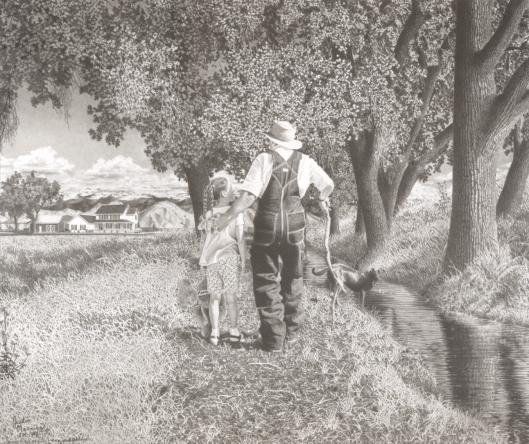
Lithograph Courtesy of the artist Justin Manning - 559-781-8291
Grandpa, Tell Me About Them Good Ol' Days
The Good Ole Days
A grandson, while talking to his grandfather asked, "What do you think of
the shootings at school, the computer age, and just things in general."
Grandpa replied, "We'll let me think a minute --I was born, before
television, penicillin, polio shots, frozen foods, Xerox, contact lenses,
Frisbee, and the Pill. There was no radar, credit cards, laser beams or
ball-point pens. Man had not invented pantyhose, air conditioners,
dishwashers, clothes dryers, and the clothes were hung out to dry in the
fresh air and man hadn't yet walked on the moon.
Your grandmother and I got married first-and-then lived together. Every
family had a father and a mother, and every boy over 14 had a rifle that
his dad taught him how to use and respect. And they went hunting and
fishing together.
Until I was 25, I called every man older that I "Sir" and, after I turned
25, I still called policemen and every man with a title "Sir". Sundays
were set aside for going to church as a family, helping those in need,
and visiting with family or neighbors. We were before gay-rights,
computer -dating, dual careers, daycare centers, and group therapy.
Our lives were governed by the Ten Commandments, good judgment, and
common sense. We were taught to know the difference between right and
wrong and to stand up and take responsibility for our actions. Serving
your country was a privilege, living in this country was a bigger
privilege.
We thought fast food was what people ate during Lent. Having a
meaningful relationship meant getting along with your cousins. Draft
dodgers were people who closed their front doors when the evening breeze
started. Time-sharing meant time the family spent together in the
evenings and weekends not purchasing condominiums. We never heard of FM
radios, tape decks, CD's, electric typewriters, yogurt, or guys wearing
earrings. We listened to the Big Bands, Jack Benny, and the President's
speeches on our radios. And I don't ever remember any kid blowing his
brains out listening to Tommy Dorsey.
If you saw anything with "Made in Japan" on it, it was junk. The term
"making out" referred to how you did on your school exam. Pizza Hut,
McDonalds, and instant coffee was unheard of. We had 5 & 10 cent stores
where you could actually buy things for 5 and 10 cents. Ice cream cones,
phone calls, rides on a streetcar, and a Pepsi were all a nickel. And if
you didn't want to splurge, you could spend your nickel on enough stamps
to mail one letter or two postcards. You could buy a new Chevy Coupe for
$600 but who could afford one? Too bad, because gas was 11 cents a
gallon.
In my day, "grass' was mowed, 'coke' was a cold drink, 'pot' was
something your mother cooked in, and 'rock music' was your grand-mother's
lullaby. 'Aids" were helpers in the Principal's office, 'chip' meant a
piece of wood, 'hardware' was found in a hardware store, and 'software'
wasn't even a word.
As we were the last generation to actually believe that a lady needed a
husband to have a baby. No wonder people call us "old and
confused" and say there is a generation gap.
and how old do you think I am??
Note: This man would be only 59 years old.
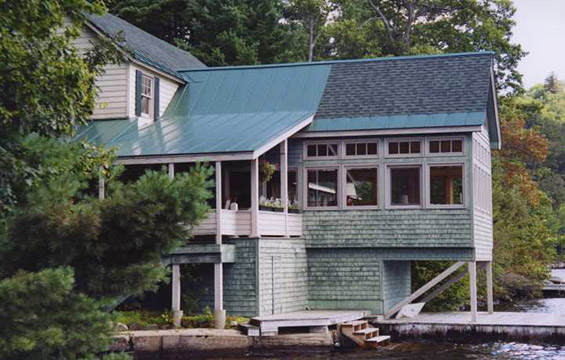
So, Why the "Great Camps" of Canada Lake?
In a nutshell... Because it is such a pleasure to meet the gracious owners of these camps, get to know them, and take a peek inside. Not to mention recording some much needed history of these camps and their owners. No doubt most of you would like to do the same.
What really started it all was.....
Interviewing Barbara McMartin for a tribute to her by this web site, along with taking pictures of her home on Canada Lake. I realized how neat it would be to have a few pages of pictures of each of the older camps/homes on Canada Lake. "Older" for starters as there are a number of newer camps that can/will be included.
I mentioned my idea for "Great Camps...." with a few owners of the first camps I wanted to feature. All were in agreement that this undertaking would be of interest to many, for they would also like to see the other camps.
This confirmed my own thinking as many times I, no doubt like you, would drive by a camp and wonder what it looked like inside. Who owned it. For how long. Who was the original owner. Who was sitting there under the soft yellow glow of a reading lamp in the early evening as I drove by. What view of the lake does the lakeside deck/porch present you. How old. What kind of boat is in the boathouse, etc. ,etc.
So, this is the "why" of the "Great Camps of Canada Lake." I've only a few weeks this year to start as it's already 9/2/04, but next summer I should have a great number of web pages showing these camps and their owners. My plan is to extend the "Great Camps...." to Caroga, Pine, and Peck's Lake.
Here's our first "Great Camps of Canada Lake":
Be sure to turn up your sound!
- Barbara McMartin and Alec Reid
- John and Eveline Brower's Camp
- Rohrs - Healey Camp
- Clark Camp
"Great Camps of Caroga Lakes":
- Nestorest - Larry D'Alessandris
Memories of our...
Caroga Times Visitors and Friends
Let us know of your memories of "The Lakes," or read about others. No doubt from some people you know!
We Would Love to "Hear" From You
October 22, 1999
Tony,
I love your site !!! For the merry-go-round to be the first visual, nearly brought me to tears, what memories!! I don't have much time now, but I really wanted to thank you. I can't wait until this evening when I can really stroll down memory lane.
Have a wonderful day, I certainly know that I will. Thanks again and take care !
Jo Anne Walters
10/29/99
Hi Tony,
Thank you ever so much for sending me your FANTASTIC website CAROGA TIMES.
When I was a young child, I use to beg my parents to take me to Caroga Lake and Pine Lake. I most definitely remember many of your great shots of Caroga Lake. I stayed up half the night enjoying your site and reminiscing.
Tony, the most amazing thing is that I think my parents knew your parents. Mike and Mimi (Biasini) Myzel were friends of my family, also. I think that she was a very good friend of my Aunt Honey (Carmelia Di Spirito). I recognized Mimi's picture immediately. My parents (who are now both deceased) were Kenneth and Lena Taddune. I also believe that your parents knew my uncle and aunt (Pete and Rose Raneri) very well. It really is a small world, Tony.
Thank you again for taking me back to the good times and letting me live my childhood once more. God Bless, Tony, and take care.
Marietta (Taddune) Blaisdell
Hi, Linda again! I loved the Caroga site! My brother is going to freak, he lived there for quite awhile before moving to Frankfort. Thanks
Linda Mcdaniel Knowles
Hi Tony. . . .Thanks for the "Reach Out And Touch" contact. You put together one H--l of a Web Site. It is great to have access to so many pix. I did not have time to view all of them, but I also had a hard time getting myself to stop clicking for the next one!
Your Web Site is well done. From the little note at the bottom of your Home Page I deduced that you do Web Sites as a business. I have put up and continue to maintain 3 or 4 so far, free of charge, because mine are fairly simple, nothing too fancy, and at my age (pushing 80) I have little interest in going into business. If you like, you can check out the one I put together for the large local group of former employees of the company I worked for until I retired. Click on: www.worldaccessnet.com/~exch2m to see the little magazine I put together so we can continue to stay in touch.
I ran into the J'town Web Site quite by accident but I was truly delighted to have found it. I have many fond memories of the beginning years of my life there. After enlisting in the Army in Feb. of 1942, I spent no more time in J'town except for a couple of months following my discharge in Dec. of 1945. I spent the next 22-23 years or so in the San Fernando Valley before moving to Portland, OR in 1969. In 1989 I moved To Vancouver, WA.
Your name does not ring a strong bell in my memory----I graduated from High School in 1938----are you in the same generation as I am? The photos depict you as a much younger person then me. And I fail to bring up any memories of "His Honor, the Mayor" and his connection with any business I am familiar with in J'town.
Nevertheless, I thank you for making contact; it was very generous and considerate of you to share some old memories with me.
C. J. (Gus) Pantazi
Tony:
Awesome, can't say when I enjoyed an afternoon better than this - with goose pimples up and down my arm in recollections of the Caroga Lake and Adirondacks.
The best of my life has been at Caroga Lake since I was 15 years of age - let's see - that makes it 66 years. In fact I bought a History of Caroga Lake Book many years ago, and now I can't remember where I may have put it. I hope I didn't leave it a Camp Irene on East Caroga Lake North Shore or Garlock Rd.
Some of the greatest times of my life were spent there. So what are you doing in California, and I in Palm Harbor, FL.
I want to thank you most sincerely for looking me up, and directing me to the wonderful pictures you depicted in your Web Page. Someday I hope to do the same, but at the moment I'm in limbo as to how to create such a magnificent page of Caroga and vicinities. I'll try to dig up some pictures that I have laying around and scan a few for you as I'm able.
What memories, what GREAT times. We may have even crossed paths at one time or another. Wish I could remember names of places better, but out of sight - out of mine. I owned a camp on East Caroga Lake and was a Director of the East Caroga Lake Asso. for some 15 yrs., Back then I also started a Saturday afternoon regatta of sailboats every Saturday afternoon, and on the 4th of July - fireworks and flares around the Lake that is still in operation to this day.
Dancing at Sherman's Pavilion at ..10cents a dance for (3) sets was the epitome of pleasure derived. Who would ever go with a date to Sherman's when he could dance with 50 girls on a week-end? My first wife died from cancer at an early age of 42, but the Big Bands at Caroga were something else. When I remarried my new wife Jackie and I won a few dance contests when Paul Volk was in charge before the fire. Now, when we pass by Sherman's it about tears my heart out to see everything boarded up, and no where to go anymore in that direction.
Once again Tony - I appreciate your generosity and your offering of nostalgia.
Ted Kitler 2015 Groveland Rd Palm Harbor, FL 34683 PS- We still spend 3 months plus in the Adirondacks during the summer months - mostly on Great Sacandaga Lake.
Dear Tony=
Thanks for sharing your page with me = you graduated the year after and the year before my sister and brother -- It was fun to look back.
Nancy Robinson Hauck
Hi Tony,
What a great web site. Haven't had time to view all of it yet, but will shortly. Hope to see you at our class reunion in 2000. It's hard to believe it's been 40 years. Boy, do I feel old. Loved the pictures of the young Tony Ermie. Brought back a lot of memories.
Looking forward to seeing you.
Sharon
<**>**<**>**<**>**<**>**<**>**<**>
Sharon Manno
Hi,
THANK YOU SO MUCH. I cannot tell you how happy you just made me. It wasn't long ago I was telling stories about summer visits to Caroga and how great Sherman's was. I loved that place so much. My daughter just could not conceive of what it was like seeing it today. I will treasure this and share it with many .
God Bless and please keep me on your mailing list as you make updates. I very much appreciate it.
Take care and stay well.
With Love,
A lifelong fan of Sherman's
Ruth Corey of Delaware
3/12/04
Tony, thank you so much for allowing me to go back to the good old days and Caroga Lake. We were you're neighbors on
Fon Claire Street and I knew your Mom and Dad very well. I have so enjoyed the articles that I have read and surprisingly,
I remember most of everything you talk about. Please keep up the good work. I am now in Florida but I am determined
to go to Sherman's this summer while visiting up there. Thanks again.
Helene ( Walsh ) Hladik
3/16/04
What a great site!!! I have never been to your lake or town but we are making a trip this weekend to look for a vacation
home in the area (03/20/04).
My wife and I have been searching for a long time now and think that we have found a camp/house near the lake. Makes
me feel good to see all the pictures and read about the history and good times that everyone is and has been having.
Keep up the good work!!
Jerry and Jennifer Rasiak
Long Island , N.Y.
3/21/04
Tony (et al),
I spent a pleasant 2-1/2 hours this morning going thru the Johnstown section of your web site. CONGRATULATIONS !!
AND WELCOME BACK. I'm an old Johnstonian (twice removed) and I enjoyed every minute of it.
I have a lot of old photos of J'town and activities circa 1948 - 1951. I also have a lot of pictures of OLD J'town that most people
would not recognize. MY fathers' uncle was William Kibbie who ran Kibbie Photo Studios back in the late 1800's. At the moment,
most of the pix are buried under a lot of other stuff (having moved up here in 1999 and have not set aside time to sort out and classify
all the artifacts. I'm not sure that you would remember me but, you might be familiar with my brother - Richard Calderwood
who lived in J'town for many years. I would like to contribute to your "collection" in the future with some of the photos.
Donald J. Calderwood, Sr. ([email protected])
13 South Park Street
Cambridge, N.Y. 12816
3/21/04
Well, Ernie you did it again brought back the memories and tears. Although I was raised in Arkansas I fell in love with the area
in and around Caroga Lake when I first saw it on a sat. Night in 1957 as a new bride.
Loved the new pictures .
Juanita (Manchester) Booth.
Baytown Texas.
3/21/04
Thanks for the up-date, Tony. Hope we can meet you this year when you are in Caroga again. Will look for your electric car!!!
It looks like a good idea to have one like that with gas prices going higher all the time.
We will be camping in our trailer at Peck's Lake again this summer. It may not be early in May, though, as we have lots of snow
and it is in the 20 degree range here in Little Falls today. The calendar says "Spring", but it sure doesn't look like it outdoors yet.
Sincerely,
Marion (Mosher) Keyser
3/21/04
Thanks again. You have done a great job with this. Have sent it on again
to family who spent summers at Canada and Caroga lakes. Keep it up.
Takes me back a few years....I'm 82
Percy
3/21/04
Tony,
I don't respond very often, but looking through the site today brought back some great memories.
People were kinder and gentler back then.
Was there, or not, a "tilt-a-whirl" at Caroga? I know I milked all the sympathy I could get from the
Little Falls girls one summer when I nearly lost a finger in a summer job accident while at RPI.
Believe it or not there is a relationship between the injury and the tilt-a-whirl.
How did you come to be in Visalia? I lived in Lancaster for years and just drove up 99 a few days ago
after attending a Lockheed flight test reunion along with old buddy who now lives in Three Rivers.
Years ago when we frequented Caroga, no one dreamed of moving as far away as we are. Now we
are spread all over, I in Oregon now.
Jim Fitzgerald
3/21/04
Thanks Tony,
I enjoyed seeing the new pictures.....
Bill Kennedy (from Johnstown, now in Converse, TX)
3/21/04
My son sent me the link to your web site and I really enjoyed browsing through it. My husband was Gregg Smith; I believe you
worked with him at Willie’s and possibly Sherman’s cafeteria. As you may know, Gregg passed away on 3 Jun 01.
Going through your pages brought back many memories -- Gregg loved Caroga Lake and had so many stories to tell about
his time there as a teen that at times I felt as though I spent those days with him. While we own a camp on East Caroga,
I didn’t, meet Gregg until 1962 in NYC.
Some years ago, as Gregg and I were leaving our camp on Garlock Road, we spotted one of the old bumper cars, resting on
the side of a small out-building on Route 10. The old rusted car looked forlorn and as though someone had discarded it there as
mere junk. I took a picture of it because I knew it would make a good subject for a painting. Since Gregg passed away I have
pursued my love of painting and one of the first things I painted was that bumper car. I’ve attached a digital photo of the
painting (watercolor) for you to see.
Thanks for the engaging web pages – Gregg would have loved the web site.
Regards,
Irene Smith
3/22/04
Wow Tony, I'm literally oozing nostalgia. What a great adventure you are sharing with
all of us. I graduated in 1952 with Connie Ermie...any relation???? Thanks for the
memories! Warm Regards, Bernie Frank